Wednesday, 14 January 2015
#053: Before You Send that Tweet. . .

Tuesday, 13 January 2015
The cost of incomplete data
“Our customer experience is our brand.” That's how the vast majority of retailers see the role of customer experience, according to a recent Econsultancy survey.
But CX depends on a collection of data and tools that must work together to delight the customer and increase revenue.
Someone new is on your website. They're on the product page for women's scarfs.
You can certainly glean information and make some predictions from that single data point; based on the product, she’s probably middle aged and in an upper income bracket.
Or maybe she's not her at all. It's her son looking for a gift and for the next year, his inbox overflows with products targeted at his mother.
Eroneous conclusions based on incomplete data take place within ecommerce all the time.
As revealed in Econsultancy’s upcoming research, in partnership with SDL, retailers place the highest value on customer purchase history and current digital behavior when making strategic predictions about personalization and shopping habits.
These attributes are certainly useful when recommending products as the consumer is shopping, but they are insufficient for building loyalty for the long term, especially if the shopper is new (or relatively new) to the site.
There simply isn’t enough information to tell whether or not the consumer is buying for himself/herself or as a gift—and that can be especially problematic during the Christmas season and other key retail drive times, because shoppers can easily be miscategorized for future communications.

In other words, Mary Smith may be delighted that your website is recommending silk ties as she shops for her dad, but when she shops for herself, she’s going to want to see blouses and shoes.
A follow up email offering a discount on her next purchase of men’s silk ties will fall flat, and she may not shop on your site again because she feels like your brand doesn’t understand her needs.
This outcome is especially likely if Mary is a millennial, as her generation has a significantly higher set of expectations for personalization than other demographic groups.
So, what’s the remedy?
If you’re like most retailers and etailers, you’re collecting consumer data. Lots of it. And it may be stored in different databases.
The key to accurately forecasting your shoppers’ needs for better personalization is to be able to use ALL the data in an easy and actionable way.
Your company may have a super CMS, great analytical software and a website that optimizes the customer experience, but if these systems don’t interface together, your view of the customer will be limited at best.
You could end up trying to sell that young boy a basketball when all he wants a guitar case. Multiply this error by the tens of thousands (or millions) of shoppers who visit your website, and the lost revenue quickly escalates.

Want to learn about how leading retailers overcome this problem of data integration as well as the broader trends in customer experience management?
Join SDL and Econsultancy for our webinar on Wednesday, January 21st, The Retail Imperative: A Strategic Approach to Customer Experience.
How to create brilliant customer experiences for B2B on social
This is for the naysayers who think that social media is an alien terrain for B2B organisations.
This is also for those working within B2B who need to present a case to those higher up that social can work for their company.
This is also to celebrate the many B2B companies already using social in a way that puts a lot of B2C operations to shame.
Creating a satisfying customer experience for your social followers is not about mimicking what B2C companies do, it's about finding your own voice and your own strategy.
What should be your tone of voice?
It's no good trying to be as anarchic as Paddy Power or to convey a similar sense of fantastical wit like Waterstone's Oxford Street, especially if you're a medical supply company.
What can be off-putting to B2B companies is that the constantly trumpeted 'best brands on Twitter' tend to be the funniest, or the ones quickest with the Photoshopped image relating to a trending topic.
That's great if you're a pizza takeaway brand with 50,000 followers expecting a bit of light entertainment.
However there are many companies out there that we consider the quiet champions of social. The ones who are always open, listening to customers and replying helpfully and quickly with any kind of enquiry.
To be good at social just means being there with open ears and having a primary focus on customer service. I admire B&Q far more for their cheerfully, delivered-within-a-couple-of-minutes replies then other brands for their newsjacking of trending topics.
If you're afraid of being funny or you think it's inappropriate to your audience, don't worry about it because you don't have to be.
The key is to be human. To communicate in a natural, personal manner that shows there's a real approachable team behind the account that is there to help.
However if you're in the right field, a light touch can certainly help.

Social customer service
This is essentially ‘after-care’ and can be delivered in a number of ways.
When a client or customer has purchased a service or product from you, go and follow the individual buyer and product on Twitter. This will create an instant connection and they will likely follow you back.
Then perhaps after a week or two, why not follow up the purchase with a direct mentioned tweet (using the @name first) asking how they’re getting on?
Don’t be overzealous about it though, just in case you come across creepy. Also make sure the customer service agent includes their name in the tweet so the recipient knows there’s a genuine human behind the message.
You should definitely be monitoring the whole of Twitter for mentions of your company name (whether direct mentions or not, and also any possible variations of spelling too) and engaging with them directly, whether it’s a positive mention or a negative mention.
In fact, definitely if it’s a negative mention.
Thanks @mrchrisadams! And if you haven't checked out Watson Analytics, you might find that of interest as well http://t.co/jgPjWkK8L3
— IBM (@IBM) January 7, 2015
And of course you should be delivering customer service on social as a matter of course anyway, whether the enquiry is from a regular customer or not.
Remember to be personal, empathetic and speedy in response. Even if you have to take a customer onto a different channel (due to sensitivity of information or length of reply).
If you can’t answer the query without thorough investigation, it’s important to at least state that you’re looking into it as soon as you can.
Content marketing
B2B companies are quickly entering an increasingly socially connected and digitally savvy world, and this in turn is helping them find new and innovative ways to connect with customers.
The problem occasionally for B2B is in finding the excuse to connect with new or existing customers.
We are heading towards a connection-based economy rather than a blatantly sales focused one, and as customers are provided with more and more choice and are increasingly in control of their own online experience, they will quickly ignore any company with an aggressively sales based attitude.
So how do you maintain engagement on social in a way that keeps your brand at the top of your customer’s mind without ‘coming on too strong’?
Content marketing is a brilliant way to develop rich customer experiences, and social is a key way that helps you focus on an individual whilst reaping the benefits of a larger audience seeing it.
Content can be anything from videos, webinars, tools, blog posts, how-to-guides, news, Q&As, images, photography, infographics, podcasts... basically anything produced via any media that isn’t a simple press release or mission statement.
#EmojiScience doesn't just have to be on your keyboard- try your own version at home & show us your scientific skill!https://t.co/SM3rHcP4Zv
— General Electric (@generalelectric) December 15, 2014
Providing content specifically tailored for your customers is an excellent way to build up a relationship, not just at the beginning of a sales cycle where new buyers can be nurtured, but throughout the lifespan of your relationship.
The main difference between using content for B2B, as opposed to B2C, is in the use of different content at various levels of the sales funnel and the customer lifecycle.
However content can also be used for brand awareness, to attract, quantify, engage and nurture leads, as well as for customer retention.
The difficulty is that B2B content can often be aligned to fairly complex products and appeal to particularly niche industrys. B2B companies may also have clients in a range of verticals, making it harder to tailor content from existing materials.
The trick is to create something personal and relevant to your customer, yet shareable and appreciated by a wider audience.
Real-time marketing
Is agile marketing for B2B companies just a pipe-dream? According to our B2B Real-Time Marketing Report, 65% of B2B companies are carrying out some form of real-time marketing, and 87% agree that “real-time marketing is essential”.
The idea of B2B marketing being slow-paced is thankfully becoming redundant.
As our lifestyles become increasingly ‘always-online’ the more we demand rapid and personalised responses from the companies we engage with.
It’s also true all B2B customers already have experience with B2C vendors and their expectations may well be the same. B2B companies must try to match those expectations as best as they can.
The customer journey undertaken by B2B clients contains multiple decision makers with varying agendas, remits, and goals which has led to the common misnomer that real-time is an unrealistic concept.
However even B2C real-time marketing requires a certain amount of pre-planning. Real-time marketing means offering the right content at the right time.
B2B and B2C companies that have the right marketing processes in place will be better able to offer up content and engagement at time that a customer considers ‘now’.
We asked our respondents “what do you perceive as the main benefits of real-time marketing?”

Better customer experience is the clear winner here. Replying to customers as quickly as possible with relevant information also has the knock-on effects of improved customer retention, improved conversion and better brand perception.
In conclusion…
Modern marketers know that the internet puts people in control. Prospective buyers and brand advocates alike are going on a journey of their own making.
It’s about the creation of engaging content, being exceptionally helpful on every channel and connecting with your customers on the social platforms of their own choosing, which will help create meaningful customer experiences and therefore position your company as the only choice for the future.
Monday, 12 January 2015
Singaporean vs. Western ecommerce design: what are the UX differences?
Asia-Pacific is an important region for Western ecommerce retailers hoping to expand their businesses beyond their own domestic markets.
China is the most obvious target due to the sheer size of its population and the growing popularity of ecommerce in the country.
However other APAC nations shouldn’t be ignored as they can also provide new revenue streams.
We’ve previously covered digital trends in Singapore but have somewhat neglected ecommerce design.
To right this wrong I’ve been browsing various fashion sites which are apparently among the best that Singapore has to offer.
Here’s a brief run through of what I found, but for more on this topic download our report on the State of Ecommerce in South-East Asia.
Love, Bonito
Love, Bonito (LB) has apparently built its reputation on high quality products and excellent customer service.
While the website offers a decent overall experience it does suffer from a few UX flaws that could cause frustration among shoppers.
The most obvious issue is site speed, particularly with images on the product pages.
Product images take several second to load and there’s a long delay when you try to switch to a different photo. Incidentally, though there are five images for this dress they are all taken from the same angle.
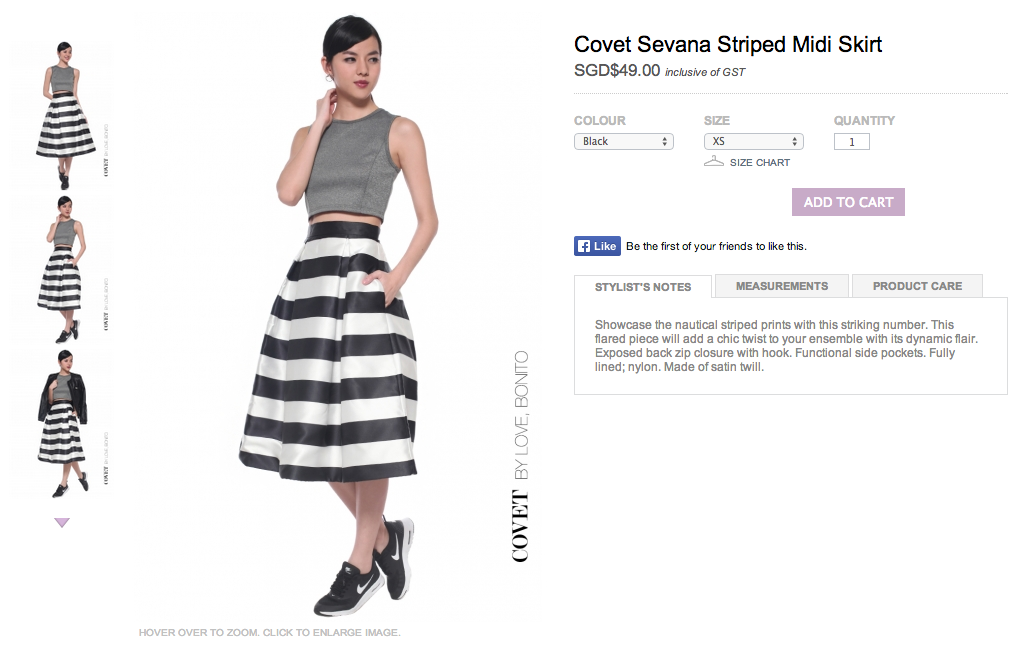
Another problem is with the stock levels. The only way to tell if the product is available or not is to select the size and hope for the best – most sites now display which sizes are available to prevent any wasted effort on behalf of the shopper.
On the plus side, you can enter an email address to be notified when your size is available.
This is good customer service and also a handy data capture tool.

At the checkout Love Bonito forces new customers to register an account. This is a huge barrier to purchase for Western shoppers, though it may have less impact for Singaporeans.
To make matters worse it asks for a lot of personal information (birthday and phone number) and requires users to enter their full name twice.
These small UX issues can add up over the course of a user journey and make it more likely that a shopper will abandon the site.
Dressabelle
Dressabelle mainly sells affordable dresses targeted at young working women.
Its key strengths are apparently comprehensive product information and free shipping, the latter of which is prominently advertised on the homepage.
There’s also a neat reindeer graphic that shows when different offers will be available.

As with Love Bonito the visuals and UX are generally of a good standard.
For example Dressabelle offers a huge range of product photos and the ability to leave product reviews. But it could also improve the UX by making a few fairly obvious changes.
One glaring omission is the lack of any product filters, which makes it difficult to sort through the hundreds of products on offer.
Also, Dressabelle doesn’t include product descriptions. The information on the product pages is limited to garment measurements and a sentence about how to wash the item.
This is missing out on a good opportunity to upsell the benefits of the product, which is important when shoppers can’t actually touch the items.
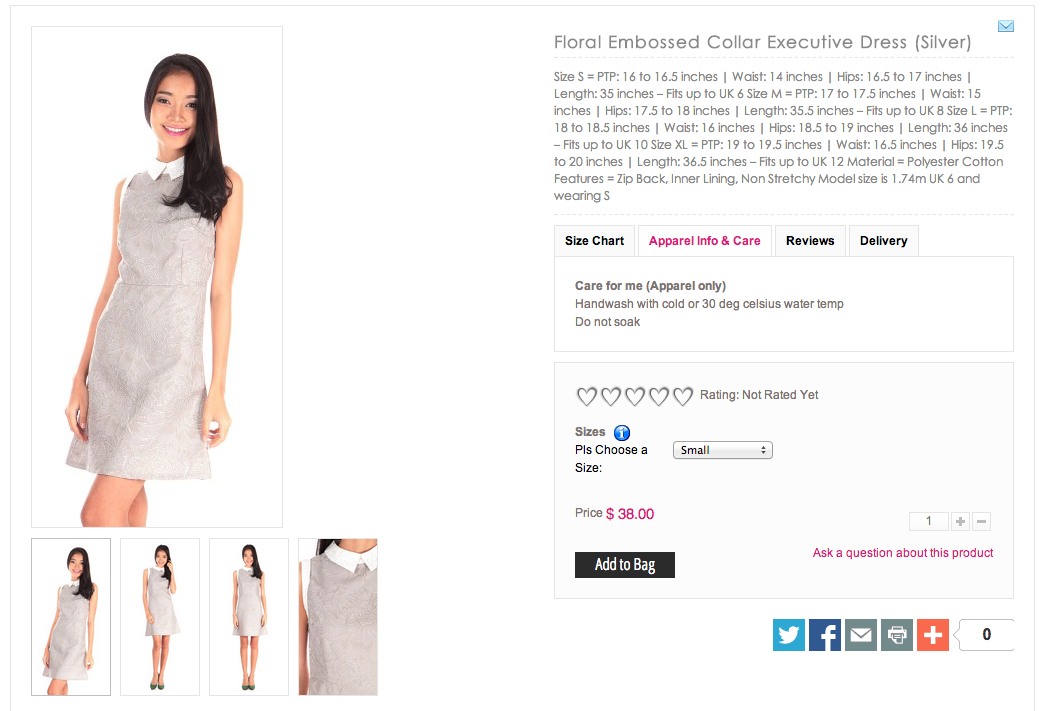
Another issue worth pointing out is the slightly strange checkout design.
Just above the shopping basket summary there is a CTA that enables you to ‘add/edit billing information’, but at the bottom of the screen there’s another for ‘check out now’.
Weirdly, both of them take you to the same address form.

But that aside, Dressabelle deserves praise for its free shipping and guest checkout option.
Reebonz
Reebonz sells luxury goods at slightly discounted prices, including handbags, shoes, watches and jewellery.
It allows customers to pay for items in instalments and also offers free shipping, however you have to register with the site before you can begin shopping.
Though I’m not a big fan of the homepage design or tiny options in the top nav, overall the site is more in line with what one would expect to see from an established ecommerce store.
For example, if you go to the bags section the layout is clean and simple, the imagery looks great, and there’s a good range of filters.

The product pages are also excellent, offering a huge amount of product information and several images that give the customer a great view of the item.
Reebonz also displays a prominent guarantee that the items are authentic. This is important as counterfeiting is seen as a major problem in APAC.

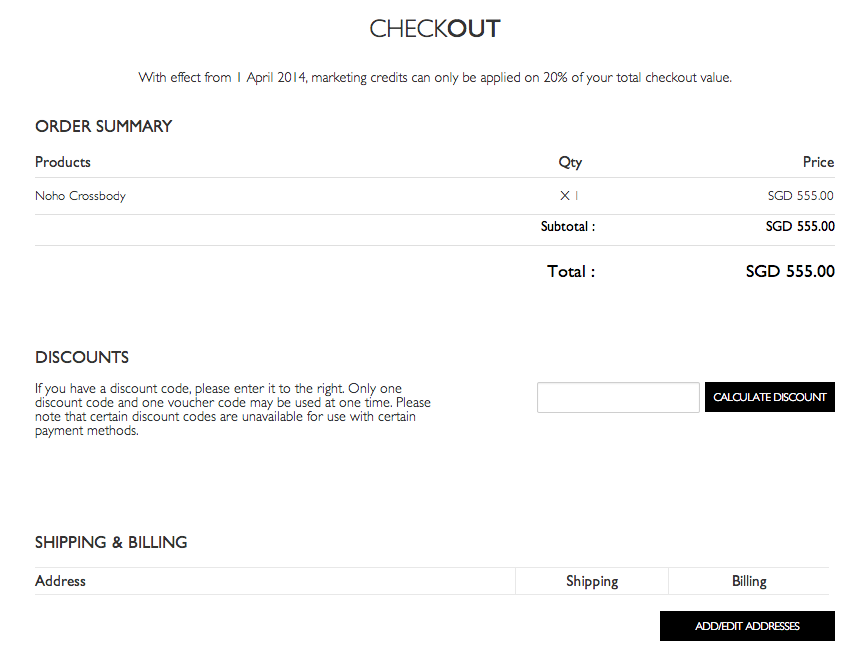
The checkout also has a clean, uncluttered design that makes good use of white space.
As I’d already logged in using Facebook the only information required at this stage was an address and payment details.
Overall it was a quick, convenient purchase journey, which is obviously important when selling luxury goods.
Zalora
Zalora sells a broad range of fashion products and apparently offers “a user-friendly interface and a simple check-out process.”
The homepage has a standard design and is certainly easy to navigate, though it would be good if the 'men' and 'women' categories at the top were dropdowns rather than navigating to a new page.

The category pages are well designed and offer a useful number of product filters.
There’s also a neat tool that displays the sizes available when you hover over a particular product option.

The product pages give a broad range of information including a decent description, care and size details, and delivery information.
There’s also a good number of product images, a massive CTA and prominent reminder of Zalora’s free returns offer.

At the checkout Zalora scores points for taking a subtle approach to new customer registration, though the page layout is a bit confusing at first.
On the plus side it does include many features that we would consider to be best practice, such as:
- Social login option.
- Security logos.
- Numerous payment options (cash on delivery is still very popular in APAC).
Zalora also retains its big black CTA design and commendably has managed to fit the entire payment process onto a single page.

In conclusion...
These Singaporean fashion retailers adhere to much of what we’d consider to be best practice in the UK, though with some flaws as I’ve pointed out above.
The only major difference would appear to be the prevalence of Facebook login and the fact that three of the four require all new users to register.
Guest checkout is a common feature among Western ecommerce sites and it’s fairly unusual to see Facebook offered as a login option.
This last point could be down to trust issues among Western consumers in regards to social logins, or the fact that Western ecommerce sites want to own the data rather than relying on Facebook.
Either way, it’s one that I’ll look to investigate in a future post.
How To Build A Culture of Content
One of the biggest issues we see in the brands who are struggling with content marketing, no – in the brands who are struggling with marketing overall – is culture. Marketing at many B2B brands emerged out of the sales team’s need for more leads. Marketing generally started in the field, hosting events, hanging logos and grabbing business cards. In B2C, marketers started in the traditional advertising side of the house where the game was all about reach and frequency. But again, the goal was about getting the brand message out to the target audience – with the logo attached. [...]
The post How To Build A Culture of Content appeared first on B2B Marketing Insider.
Four important reasons why marketing should be personal
Personalisation is a fundamental part of digital strategy and a strong commercial case for using it is as follows: a reported 14% uplift in sales.
This stat comes from our quarterly digital intelligence briefing Why Marketing Should be Personal produced in partnership with Adobe.
The report, based on a global survey of around 700 client-side and agency respondents, explores personalisation, a topic which has quickly risen to the top of the agenda for companies wanting to improve customer experience and financial performance simultaneously.
Here are just four reasons why you should be creating more personalised marketing.
Better customer experiences
Serving relevant personalised content throughout the online journey will help create a deeper relationship between your business and the customer. It’s important to remember that prospective buyers and customers alike are going on a journey of their own making, so marketers should be aware that creating personalised content will help position their business as the only logical choice.
This can lead to much higher levels of brand advocacy and will hopefully improve customer lifetime value.
Improved conversion rates
As the link between an improved customer experience and better commercial performance has become more obvious, the ability to personalise is rightly seen as something which can help differentiate you from competitors, which can also help lead to that possible 14% uplift in sales.
We asked our respondents: How do you (or your clients) measure the benefits of personalisation?

Real-time personalisation can improve sales even further
Real time personalisation can result in an uplift in sales which is 33% greater than those businesses who say their type of personalisation isn’t instantaneous.
Tailored content can be delivered at times when customers are most receptive and in ways that are more likely to stimulate engagement.
Companies targeting personalised content in real time are seeing, on average, 16% uplift in sales. This is higher than the uplift of 12% seen by those who are carrying out personalisation but not in real-time, translating into a significant amount of additional sales for businesses across a range of sectors.
Improved customer experiences without the creepiness
The personal touch is a time-honoured way for businesses to keep their customers loyal in the offline world, however it is only relatively recently that technology has enabled businesses to do this at scale online.
As our Modern Marketing Manifesto states:
Digital channels in particular allow us to use everything we know about a customer to inform and optimise each interaction. Location, device, screen size, usage characteristics, the weather… we are in an era where we have exciting and powerful new data points to power personalisation.
However it’s important to remember that as modern marketers we should respect the privacy of customers and recognise that value must be delivered to them exchange for personal data.
Personalisation does not necessarily require personally identifiable information to tailor the experience. There is a whole range of data about individuals which can be used to customise the experience without knowing exactly who they are, for example if they are visiting your website for the first time.
Download the full copy of the report Why Marketing Should be Personal to learn more.
For a further look at some of the most important trends affecting the marketing landscape, you can download more reports here: Econsultancy's Quarterly Digital Intelligence Briefings.
Social listening in 2015: top five opportunities
Social listening has come a long way in a short time.
We assess the year's big five opportunities for building and strengthening customer relationships and driving advocacy.
Social listening’s growth and evolution have progressed quickly in recent years. The way we’re using the data is creating more opportunities in a marketing context than ever before.
Using social media to your advantage is a common brand goal these days. The platforms provide an ‘always on’ focus group, never shy to provide opinion, warts and all.
But as the technologies continue to evolve and brands and their agencies become more adept at gleaning meaningful insight, what are the top five opportunities that social media listening brings to the marketing table this year?
1. Look beyond commentary to analyse behaviours
Anecdotal comments can be useful, and it’s relatively easy to track recurring subjects, but it’s also worth analysing how users behave and react in different social spaces.
This can be used to refine content plans, trial different ways of using copy and pictures to drive repeated and long-lasting engagement.
Several monitoring tools provide insights on platform use time, and although data is often uncharted for niche sites hosting loyal communities, expect the breadth and depth of audience behaviour data to improve.
2. A picture can still say 1000 words, but…
The rise and dominance of imagery within social media is another relatively new field and one which data providers currently have a hard time supporting.

Excluding specialist sites like TOTEMS, social listening platforms are currently limited in terms of the coverage they can provide for sites like Instagram.
As it’s now owned by Facebook, this is likely to be an ongoing issue, but the need for multiple monitoring suites doesn’t only incur extra costs, but it adds barriers to the way we monitor data and present it back in a streamlined manner to help refine ongoing strategy.
This year, expect the major platforms to work hard to rectify ‘picture blindness’, providing useful data to feedback to content teams who select the nature and number of imagery.
3. When it comes to privacy, honesty is the best policy
Last year, Twopcharts reported that 5% of all Twitter accounts were protected, and while comparative Facebook stats are tricky to track, we know this figure is considerably higher.
Protected profiles are masked to many monitoring tools and with the rising popularity of Snapchat, which is very much about user privacy, the platforms and analysts will work hard this year to get a handle on all the social media chat going on behind closed doors.
With Facebook and Twitter, deeper insight can be unlocked by marketers prepared to release the purse strings and book ads but the data is often ‘broad-brush’ and it’s not easy to drill down to reach specific opinions and trends at a brand level.
In 2015, I expect to see more brands being up-front and honest with consumers who engage directly with them. In return for being able to access personal details and track useful comments, brands will need to make it worth consumers’ while and stick rigidly to the deal by not bending or infringing any privacy rights once they’re in place.
4. Partnerships to shine a light
The evolution of social media monitoring has presented opportunities to delve deeper into data streams than ever before.
Different technologies are working together (or acquiring each other), for example with Hootsuite, to inform content and community management strategy.
With more partnerships in place, teams will be able to use singular dashboards to analyse and respond.
5. 2015 could be the year we finally join it all up
In isolation, data from social media monitoring is useful. But it’s even more revealing and powerful when it’s integrated with other CRM systems.
Social data is being used on a more widespread scale to segment people who, according to traditional segmentation, are demographically identical. If the brand is an online retailer, it’ll also have a wealth of analytics data to overlay and marry to customer records.
This takes investment, but forward-looking brands are now seeing tangible and attributable value to support the business case, not just in terms of improving the relevancy of messaging to boost conversion, but also in improving targeting to reduce wastage.
Would love to hear what you think...