Monday, 12 January 2015

How To Build A Culture of Content

One of the biggest issues we see in the brands who are struggling with content marketing, no – in the brands who are struggling with marketing overall – is culture. Marketing at many B2B brands emerged out of the sales team’s need for more leads. Marketing generally started in the field, hosting events, hanging logos and grabbing business cards. In B2C, marketers started in the traditional advertising side of the house where the game was all about reach and frequency. But again, the goal was about getting  the brand message out to the target audience – with the logo attached. [...]

The post How To Build A Culture of Content appeared first on B2B Marketing Insider.

Four important reasons why marketing should be personal

Personalisation is a fundamental part of digital strategy and a strong commercial case for using it is as follows: a reported 14% uplift in sales.

This stat comes from our quarterly digital intelligence briefing Why Marketing Should be Personal produced in partnership with Adobe.

The report, based on a global survey of around 700 client-side and agency respondents, explores personalisation, a topic which has quickly risen to the top of the agenda for companies wanting to improve customer experience and financial performance simultaneously. 

Here are just four reasons why you should be creating more personalised marketing.

Better customer experiences

Serving relevant personalised content throughout the online journey will help create a deeper relationship between your business and the customer. It’s important to remember that prospective buyers and customers alike are going on a journey of their own making, so marketers should be aware that creating personalised content will help position their business as the only logical choice.

This can lead to much higher levels of brand advocacy and will hopefully improve customer lifetime value

Improved conversion rates

As the link between an improved customer experience and better commercial performance has become more obvious, the ability to personalise is rightly seen as something which can help differentiate you from competitors, which can also help lead to that possible 14% uplift in sales. 

We asked our respondents: How do you (or your clients) measure the benefits of personalisation?

Real-time personalisation can improve sales even further

Real time personalisation can result in an uplift in sales which is 33% greater than those businesses who say their type of personalisation isn’t instantaneous.

Tailored content can be delivered at times when customers are most receptive and in ways that are more likely to stimulate engagement.

Companies targeting personalised content in real time are seeing, on average, 16% uplift in sales. This is higher than the uplift of 12% seen by those who are carrying out personalisation but not in real-time, translating into a significant amount of additional sales for businesses across a range of sectors.

Improved customer experiences without the creepiness

The personal touch is a time-honoured way for businesses to keep their customers loyal in the offline world, however it is only relatively recently that technology has enabled businesses to do this at scale online.

As our Modern Marketing Manifesto states:

Digital channels in particular allow us to use everything we know about a customer to inform and optimise each interaction. Location, device, screen size, usage characteristics, the weather… we are in an era where we have exciting and powerful new data points to power personalisation. 

However it’s important to remember that as modern marketers we should respect the privacy of customers and recognise that value must be delivered to them exchange for personal data.

Personalisation does not necessarily require personally identifiable information to tailor the experience. There is a whole range of data about individuals which can be used to customise the experience without knowing exactly who they are, for example if they are visiting your website for the first time. 

Download the full copy of the report Why Marketing Should be Personal to learn more.

For a further look at some of the most important trends affecting the marketing landscape, you can download more reports here: Econsultancy's Quarterly Digital Intelligence Briefings.

Social listening in 2015: top five opportunities

Social listening has come a long way in a short time.

We assess the year's big five opportunities for building and strengthening customer relationships and driving advocacy. 

Social listening’s growth and evolution have progressed quickly in recent years. The way we’re using the data is creating more opportunities in a marketing context than ever before.

Using social media to your advantage is a common brand goal these days. The platforms provide an ‘always on’ focus group, never shy to provide opinion, warts and all.

But as the technologies continue to evolve and brands and their agencies become more adept at gleaning meaningful insight, what are the top five opportunities that social media listening brings to the marketing table this year?

1. Look beyond commentary to analyse behaviours

Anecdotal comments can be useful, and it’s relatively easy to track recurring subjects, but it’s also worth analysing how users behave and react in different social spaces.

This can be used to refine content plans, trial different ways of using copy and pictures to drive repeated and long-lasting engagement.

Several monitoring tools provide insights on platform use time, and although data is often uncharted for niche sites hosting loyal communities, expect the breadth and depth of audience behaviour data to improve. 

2.  A picture can still say 1000 words, but…

The rise and dominance of imagery within social media is another relatively new field and one which data providers currently have a hard time supporting.

Excluding specialist sites like TOTEMS, social listening platforms are currently limited in terms of the coverage they can provide for sites like Instagram.

As it’s now owned by Facebook, this is likely to be an ongoing issue, but the need for multiple monitoring suites doesn’t only incur extra costs, but it adds barriers to the way we monitor data and present it back in a streamlined manner to help refine ongoing strategy.

This year, expect the major platforms to work hard to rectify ‘picture blindness’, providing useful data to feedback to content teams who select the nature and number of imagery. 

3. When it comes to privacy, honesty is the best policy

Last year, Twopcharts reported that 5% of all Twitter accounts were protected, and while comparative Facebook stats are tricky to track, we know this figure is considerably higher.

Protected profiles are masked to many monitoring tools and with the rising popularity of Snapchat, which is very much about user privacy, the platforms and analysts will work hard this year to get a handle on all the social media chat going on behind closed doors.

With Facebook and Twitter, deeper insight can be unlocked by marketers prepared to release the purse strings and book ads but the data is often ‘broad-brush’ and it’s not easy to drill down to reach specific opinions and trends at a brand level.

In 2015, I expect to see more brands being up-front and honest with consumers who engage directly with them. In return for being able to access personal details and track useful comments, brands will need to make it worth consumers’ while and stick rigidly to the deal by not bending or infringing any privacy rights once they’re in place. 

4. Partnerships to shine a light

The evolution of social media monitoring has presented opportunities to delve deeper into data streams than ever before.

Different technologies are working together (or acquiring each other), for example with Hootsuite, to inform content and community management strategy.

With more partnerships in place, teams will be able to use singular dashboards to analyse and respond. 

5. 2015 could be the year we finally join it all up

In isolation, data from social media monitoring is useful. But it’s even more revealing and powerful when it’s integrated with other CRM systems.

Social data is being used on a more widespread scale to segment people who, according to traditional segmentation, are demographically identical. If the brand is an online retailer, it’ll also have a wealth of analytics data to overlay and marry to customer records.

This takes investment, but forward-looking brands are now seeing tangible and attributable value to support the business case, not just in terms of improving the relevancy of messaging to boost conversion, but also in improving targeting to reduce wastage.

Would love to hear what you think...

Social Media Marketing 2015: Where Is Your Audience?

Is your social media marketing 2015 on track to succeed? Here are 37 facts with charts and tips to understand your audience and how it acts on social media.

The post Social Media Marketing 2015: Where Is Your Audience? appeared first on Heidi Cohen.

Friday, 9 January 2015

10 formidable distractions on the internet this week

Alright internet, it’s been more than a week since we’ve been back at work, show me what you got...

Welcome back round-up fans. Would you believe me if I said I missed you as much as you’ve missed the round-up? Yeah that leaves things suitably ambiguous. Either way, it’s nice to be back.

Please enjoy these terrific little distractions on us. The only thing we ask in return is your amusement.

Also £20,000 in unmarked, non-sequential bills which you can leave in a bag next to the green bin around the back of the office.

I am Jack’s astonishingly watertight theory

Jack Durden has created a lengthy, well illustrated webpage detailing his theories on Fight Club, particularly how almost every character is a figment of the unnamed narrator’s imagination.

The most compelling arguments of which centre on Marla.

It’s not as crack-pot as you may assume it will be. Well maybe a little. 

Cards Against Abbey

Cards Against Humanity is funny and brilliant, right, because anyone playing it can pull out a card saying 'Gary Glitter' and it’s funny because it’s offensive and brilliant, and it’s also funny when ladies who star in the very posh Downton Abbey play Cards Against Humanity because you get to hear them say 'farts' and 'wee' and 'Gary Glitter'.

Where the grass is always redder on the other side

A wonderful mixture of retro tourist posters and space nerdery, NASA has produced these gorgeous posters for Kepler-186f, the first Earth-size planet discovered in a potentially 'habitable zone'.

Time to pack your space-boots and dehydrated food sachets!

Taken Over

Here's a glimpse into the next million Taken sequels courtesy of Upright Citizen's Brigade.

We're going to need a bigger crib

In an almost too-brilliant-to-be-truly-considered-weird-or-cruel move, this uncle has built his baby nephew a Jaws themed crib.

"I’ll babysit him for three, but I'll change him and burp him for ten“.

Thrasher Price

Here is Slayer played rather convincingly well on some children’s musical instruments. Note child running around like a true metal hero.

Vulgar Display of Bebop

Jazz is great. Metal is great. If you hate either of those things, this is probably not the place for you.

Unless however you happen to enjoy pop culture restyled in wacky new formats, then you’ll love Metazz’s heavy metal albums with 50s jazz covers.

It's essentially the bread and butter of our weekly round-up.

A whole new world

Way more chilled out then spending an actual day at Disneyland, here’s a really quite beautiful time-lapse video of a single day spent at Disneyland captured in 20,000 photos and where not one Goofy is seen being kicked in the nuts.

From despair to where

Prepare for a disquieting journey down roads perhaps best not travelled down thanks to photographer Andy Lee and his collection of forlorn looking, rarely travelled down highways.

Probably should have used the sat-nav.

Raiders of the Lost Bark

Here are some dogs and cats pretending to be Indiana Jones. Look it’s only the first week of January okay, there’s not a lot flying around.

That’s your lot for this week. Me and the internet are off to get tattoos.

The internet’s getting a unicorn shooting glitter out of its horn. I’m getting the same but with flames bursting out of its eyes as well.

15 captivating stats from around the digital world

Well I guess stats why they call it the blues.

And you can beat those January blues with our first stats round-up of the new year. Filled to the brim with the very best data analysis on digital marketing and ecommerce this week.

Then maybe afterwards we can find out exactly where the brim of the internet really is.

Amazon’s Christmas

Amazon shipped 5bn items in 2014, with 40% from third-party sellers. According to the company, third-party sellers sold more than 2bn items in 2014.

Those 2bn items came from more than 2m sellers, which accounts for over 40% of the total units sold on Amazon.

Christmas mobile stats

Affiliate Window has revealed the following stats for mobile retail in December.

  • Boxing Day saw an excess of 50% of traffic through a mobile device for the first time ever.
  • 47,100 sales each day originated from a mobile device (smartphone and tablet).
  • 19,900 of these were through a smartphone.
  • 664 clicks originated from a mobile device every minute.
  • 822 sales were generated through a smartphone each hour.
  • 32.75% of revenue generated for its advertisers in December was through a mobile device.

A fifth of holiday shoppers wait until the last minute

Nearly 20% of all holiday shoppers wait until the last-minute to buy their gifts according to Retale. 

58% of all last-minute shoppers use smartphones and tablets to help them shop and among this group 88% use their mobile devices to locate stores and check store hours as they get closer to Christmas Day.

Online vs. in-store shopping

Nextopia has shared the following infographic on why consumers prefer online shopping, including such stats as 44% of shoppers surveyed said they are more likely to purchase online if they are able to pick up in-store, and that 62% are more likely to shop online if they can return an item in-store.

Christmas shopping woes

According to JDA/YouGov research nearly one in three British online Christmas shoppers experienced problems with orders. Here are some more stats from the survey:

  • 49% had suffered from missed deliveries, while 45% had experienced late deliveries or never received their goods.
  • 47% of Brits did at least half of their shopping online; of those who did Christmas shopping 18% stated that they did more Christmas shopping online than they originally planned.
  • 29% ended up ordering items earlier than planned as a result of retailers setting ordering deadlines a week or more in advance of Christmas Day.
  • 17% of shoppers stated that ordering deadlines had made them shop at a store instead of online.

Christmas click and collect

From the same YouGov research, here are some stats for click and collect usage in December: 

  • 39% of online shoppers opted to use click and collect services this Christmas.
  • One quarter of shoppers stated they chose to shop specifically with a retailer that offered click and collect over one that solely offered home delivery.
  • 19% of online shoppers used an alternative retailer this Christmas as result of their preferred one not having items available online or having delivery times that met their requirements.

Although 40% of click and collect shoppers had a very positive experience of using the service, 35% of users encountered negative issues:

  • 30% experienced long waiting times due to a lack of in-store staff.
  • 29% cited a lack of a dedicated area in-store for click and collect purchases.
  • 25% said staff were unable to look or took a long time to source goods in-store. 

There’s more on click and collect here: What have we learnt about click and collect this Christmas?

One quarter of shoppers will return goods

Retale has polled holiday shoppers and discovered that nearly one in four will return or exchange at least one of the presents they received this holiday season. Here are some additional stats:

  • 70% prefer to return or exchange gifts in-store versus online.
  • 62% said the in-store return and exchange process was convenient.
  • Nearly 40% called the online return and exchange process inconvenient.
  • 85% want retailers to allow in-store returns or exchanges of gifts bought online.

Non-marketing stat of the week

There were more than 22,000 manmade objects orbiting the Earth in 2013.

Then in October that year, the upper stage of a Russian rocket disintegrated in low Earth orbit and now there are 500 more.

Retailers could do more for mobile shoppers

Somo has analysed the mobile capabilities of the top 50 high street retailers, finding that:

  • 40% do not have a mobile optimised store locator.
  • 20% don't have a transactional mobile site.
  • 30% don't have an iOS app.
  • 28% don't have an Android app.
  • 44% do not have a tablet optimised site.
  • 46% don't support responsive web design. 

Personalised marketing set to dominate 2015

Here’s an infographic from Formstack, claiming that 45% of online shoppers are more likely to shop on websites offering personalised recommendations, while personalised triggered emails boast 25% higher open rates and 51% higher click-through rates.

Click the image for more info.

YouTube's most watched ads of 2014

According to Google itself, the top 10 ads earned a combined 330m views globally and contrary to expectation, Sainsbury’s Christmas ad topped the charts, racking up more UK views than the John Lewis Christmas advert.

Here’s the chart.

  1. Sainsbury's Christmas 2014 Ad
  2. John Lewis Christmas Advert 2014 #MontyThePenguin
  3. Nike Football: Winner Stays
  4. Nike Football: The Last Game 
  5. Always #LikeAGirl
  6. Three #SingItKitty
  7. Marks & Spencer #FollowTheFairies
  8. Save the Children - Most Shocking Second a Day
  9. Guinness - Sapeurs
  10. Pepsi Max - Human Loop the Loop

Four big reveals from CMOs

Conductor has asked 182 marketing executives about where they think the digital media industry is heading in 2015:

  • 61% of marketing executives say data is “more” or “much more” important than it was 12 months ago.
  • 65% of marketing executives plan on spending more on marketing technology in the coming year, with a large percentage (28%) planning to spend significantly more (25% or more).
  • On a 4-level scale from “not important” to “very important,” customer research was “very important” to content creation across all organisation types (B2B, B2C, Agency).
  • Agencies were most in agreement about the need for pre-content research; 85% of agency executives deemed it “very important” while 76% of B2B executives also described it as “very important.”
  • 90% of those surveyed agree that inter-department support is “important” or “very important” to their brands’ digital marketing success.

Responsive email design is no longer optional

Instiller and Wyzowl have created this infographic full of stats to show how responsive email design *is* email design.

Click below for a much longer version.

Get away

A recent report by Hotels.com stated that traffic to UK booking websites peaked at 8pm on 28 December.

According to the Telegraph, Thomson and First Choice reported record traffic over Christmas and Boxing Day, with nearly 940,000 people researching holidays on the internet. A 30% rise on last year.

The most popular time for holiday searches on Boxing Day was apparently between 9pm and 10pm during the Birds of a Feather Christmas special. 

Make of that what you will. As a side note, here are 10 essential features all travel websites must have to capitalise on this.

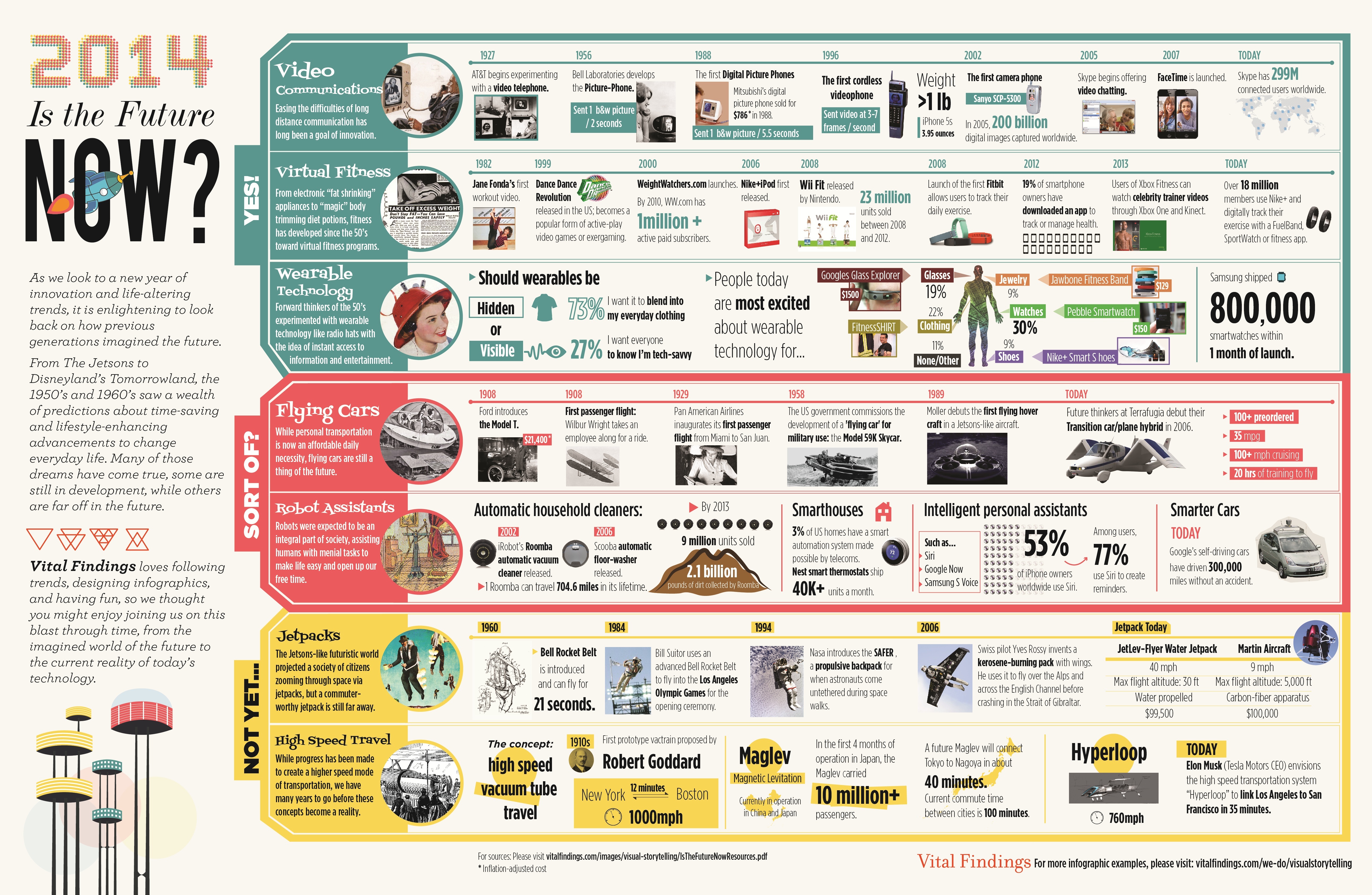
Non-marketing infographic of the week

Let’s check to see how many fanciful sci-fi predictions from the 50s and 60s have now come true as we enter the year 2015, a time when Marty McFy would eventually misplace his sports almanac.

(click for larger version)

The Definitive 2015 Blog Assessment Checklist

Want to improve your blog results? Here's the definitive 2015 blog assessment checklist. Complete with 83 questions to get your blog on track to succeed.

The post The Definitive 2015 Blog Assessment Checklist appeared first on Heidi Cohen.