Want to maximize your content reach on social media? Tap into the 5 social sharing powerhouses for each piece of content. Here are 30 social sharing tips.
The post Are You Missing These 5 Social Sharing Powerhouses? appeared first on Heidi Cohen.
Want to maximize your content reach on social media? Tap into the 5 social sharing powerhouses for each piece of content. Here are 30 social sharing tips.
The post Are You Missing These 5 Social Sharing Powerhouses? appeared first on Heidi Cohen.
With automotive purchase journeys increasingly taking place online, manufacturers and dealerships have a reason to place greater focus on digital channels to pick up customers in the early phases of their research.
An AutoTrader.com study from last year found that new and used buyers spend 75% of their car research time online, while Google stats suggest that these customers take an average of 2.7 months to decide on a purchase.
This presents a challenge for automotive marketers to grab the attention of these researchers and eventually move them offline for a test drive or a visit to a local dealership.
There’s also the challenge of measuring online marketing efforts when customers use so many channels, as tracking leads from website to dealership isn’t always simple.
In this article, I'll look at the purchase journey, some examples of automotive brands online, and that tricky transition from web to dealership.
There are, of course, many variations on this. Some customers may just stick with the same brand or dealer they used the last time, while others may be genuinely more open-minded about the vehicle they want.
One common trend over the last few years has been the movement of car research from offline to online. It seems that many prefer to use the internet for the early phases of their research.
Here are a few stats:


Automotive adverts have become a kind of cliché over the years. Imagine a sleek car cruising through open highways and mountain roads to an adrenaline-pumping soundtrack, and you have the idea.
This kind of content, often produced at great expense, does have its place on TV ads and can be displayed very effectively on the web, from online videos to interactive websites. Indeed, there are some very creative and impressive examples.
However, automotive marketers also need to think about the nuts and bolts of online and how they can most effectively convert online interest into offline sales.
While digital is clearly a valuable channel for the automotive sector, it differs from others such as retail and financial in that the purchase is far more likely to take place offline.
Volvo recently decided to make the first edition of its XC90 model available to buy exclusivey online, and the fact that it sold all 1,927 cars within 48 hours may show an appetite for more online purchases.

However, this is rare and the focus, for the moment at least, is on lead generation. This means bringing online researchers into dealerships via test drive request forms and contact details for local dealers.
The challenge for automotive brands lies in the often-fragmented marketing and sales processes they operate. Creative ad teams, social media, and websites often operate within silos, with no one ‘owning’ the potential customer until they are well along the sales funnel.
Take social for example. To be effective it needs to work with other teams in the business, so that social media content is aligned with the needs of the business as a whole, and that lessons learned via social channels are fed back to the relevant departments.
Ford’s social strategy has been celebrated, and the brand has been ahead of the curve in this respect.
According to its former Global Digital & Multimedia Communications Manager Scott Monty:
It’s always been important to us to put social where it can integrate with the rest of the business: we have corporate social strategy within communications; consumer-facing social within marketing; and customer-centric social response in customer service. From there, it’s key that we interface with other members of the Ford team, such as HR, legal, product development, IT and more.
Stats quoted in a recent study from the CMO Council underline how important social already is for automotive brands, for retention as well as acquisition.
38% of consumers said they will consult social media before making their next car purchase, while 23% of car buyers use social channels to talk about their experience when making a purchase.
Auto brands are making strides here. For example, Mini has been innovative in its use of social channels to increase engagement with its followers and provide a fun experience which matches the brand’s characteristics.
It's NOT NORMAL campaign was a huge success, helping to re-establish its identity as a friendly and innovative brand.
Mini scoured the internet looking for its most loyal brand ambassadors and discovered hundreds of images and videos on social media that it then used for its campaign.
Followers could upload a creation to its Tumblr hub or by sharing it with #MININOTNORMAL, then within hours could see it on a digital poster or billboard anywhere in the UK.
As reported in The Guardian, within six weeks 230,000 people engaged with the campaign via social media. 2,217 pieces of consumer content were shared. 29,420 new fans and followers were recruited.
Mini’s Twitter following tripled and 3,853 visitors to the campaign hub went on to look for a new MINI on mini.co.uk. 11% of which became qualified dealership leads.
Brands also need to learn from what works for other sectors online. One of the success stories of the internet has been the power of consumer reviews in driving sales. Indeed, Amazon can attribute many of its own sales to its ground-breaking use of consumer reviews.
Of course, reviews are nothing new and recommendations from ‘real’ people were always likely to be more trusted than the opinions of marketers and sales people, but the internet has allowed them to be used more widely.
It’s also an area which offers great potential for automotive brands, though they have been slow to adapt, perhaps due to the fear of negative reviews of cars and dealerships.
Kia took a different view of this, recognising that reviews play an important role in the car research process, and decided to make them the focus of its marketing.
Its TV ad campaign which started last year focused on reviews, inviting viewers to see what others thought of their cars.
In what was a relatively brave move for an auto brand, Kia invited detailed reviews of its vehicles from buyers before displaying them on its website. This alone was significant, as it meant that customers could conduct their research with less need to visit third party sites.
After all, consumer reviews are, after recommendations from family and friends, the most trusted source of information online. Providing reviews on the site meant that a greater number of potential buyers could be kept within the purchase funnel from this stage.
To add to this, Kia then made reviews the focus of its marketing efforts both online and offline. Its TV ads invited viewers to head online to see what its customers thought of the cars, while the same principle was applied to print and outdoor advertising, as well as its showrooms.
As Kia’s Head of Customer Communications John Bache explained:
With customer research moving online, we wanted to adapt to that. We knew that customers were happy with our products, and we wanted to harness that. It was a leap of faith to some extent, but if people want to find reviews online they are there somewhere. We'd rather provide them and keep people on our site.
It worked too, with traffic to the Kia website up by 21% year-on-year as a result of the campaign, while visits to dealer websites rose by 72%. In addition, new vehicle registrations rose by 12% in the same period.
This is vital for automotive, as great content can catch the attention of potential car buyers in the research phase, answering key questions and providing inspiration.
Ben Davis has provided some very good examples of automotive content marketing, and I particularly like the Nissan Leaf Q&A pages, which use existing customers to explain the benefits of the car:

The transition from web to showroom is a key area, and one that many automotive brands could improve upon. Once customers are showing real purchase intent, such as using car configurator tools on websites, looking at details for finding dealers and booking test drives, then it’s vital that sales people at dealerships are ready to respond.
For example, an Arthur D Little study looking at online transformation in the automotive industry found that 60% of new car buyers see configurator tools, which allow them to test different combinations of models, colour, equipment and accessories, as very important in making a purchase decision.

If the processes are joined up, these tools also offer useful insight into a customer’s preference which should be useful for sales people.
Another vital factor is the speed of response to test drive and contact requests made online.
Online marketing can be effective for delivering leads, but this effort is wasted if sales processes aren’t joined up with offline. This is where dealerships and manufacturers need to work together.

In the BMW example above, I can select my car and configure it to my tastes and needs, before sending the details to my local dealer.
This is great, but the key will be how quickly the dealer responds, and whether the information I have already submitted online is used by the salespeople offline.
67% of all respondents expect a confirmation within eight hours of sending a request for a test drive, 22% are prepared to wait 24 hours but only 10% of consumers would consider waiting more than 24 hours for a confirmation as acceptable.
A closer link between the website and the forecourt means that brands can turn more car researchers into test drivers and purchasers. Ideally, they should arrive at the forecourt to meet a car salesman who already has an idea of the car they are considering, their needs and their budget.
Essentially, dealerships and manufacturers need to work together to join up the online and offline experiences. The ideal would be a great online car research experience, followed by a smooth transition to the forecourt, which means more sales for both, as well as more effective measurement of online marketing and how it can translate into offline sales.
Car buyers are now using the internet for research in huge numbers, and in conjunction with more traditional channels such as magazines, TV and the dealerships themselves.
This does present challenges for automotive marketers but it also opens up possibilities for the automotive brands which can provide this joined up experience for customers.
Dinosaurs not included.
Here are the most interesting digital and marketing stats we've seen this week. This week's crop takes in budget supermarkets, YouTube, retargeting, McDonald's and, of course, social media.
As always, if you want more extensive research and up to date stats, see the Internet Statistics Compenium.
Let's go..
Video advertising itself, despite the increasing popularity of video, is currently not much more than 10% of online ad spend, according the the IAB's figures below.
YouTube represents around 40% of online video consumption. YouTube is already the most popular destination for music in the world, both in terms of streams per month and monthly users. A new ad-free subscription service is expected in the coming months to capitalise on this popularity.

via Furthr.
The IAB internet advertising revenue report for 2014, in partnership with PWC, looks at the first six months' results.
Revenue total was $11.7bn in Q2 2014. Total 2014 second-quarter revenues were $1.42bn (13.8%) higher than in the second quarter of 2013 and $264m (2.3%) higher than in the first quarter of 2014.

xAd and Telmetrics have collaborated with Nielsen for a mobile shopping study in the UK. The Mobile Path to Purchase research tracks consumers from initial purchase intent to conversion, while exploring ad effectiveness among mobile consumers.
2,000 UK Tablet and Smartphone users were surveyed along with an accompanying US study. Each respondent reported that they had used their device to make a purchase decision in at least one of three key industries in the past 30 days.
Key findings:

The same study looked at gender and age. It included online survey data and observed behaviours from Nielsen's Smartphone Analytics Panel divided by sex and age group: Boomers (55+), Gen X (35-54), and Millennials (18-34).
The study shows that Gen Xers actually spend more time on their mobile devices than the younger Millennials.
Key findings based on gender and generation include:
Click to view the full infographic.

How long should a LinkedIn headline be? A blog post? A tweet or a YouTube video? SumAll has collated data on what length certain media should be to increase its chances of success.
Click through the snippet below to see the full infographic.

Opera Mediaworks’ State of Mobile Advertising report has revealed trends for Q3 2014.
Earlier this year, Android overtook iOS in impression volume. The gap widened further in the third quarter of 2014, with Android devices capturing 58% of impressions versus iOS at 30%.
In monetization terms, Google’s mobile OS gained three percentage points, compared to Q2, reaching nearly 42% of revenue in Q3. Apple still commands higher revenue at 51%, but it is lower than Q2, when it was at 53%.
Mobile video:
1 in 10 mobile ads delivered in the United States are video.
In addition, video eCPMs (effective cost per thousand impressions) were eight times higher than banner ads.
Social tops mobile:
Social networking is still the most popular category in mobile advertising, accounting for about one in five ad impressions.
Over half (55%) of consumers are put off buying products or services if they see the same ad online multiple times, according to a study by InSkin Media and RAPP Media that surveyed over 1,600 people aged 20 to 60.
Only 10% of consumers are more likely to buy something after seeing the same ad served repeatedly because of their previous web surfing behaviour (known as retargeting).
People are nearly four times more likely to be encouraged than discouraged to buy something if they see a relevant ad during their research on it. However, as an ad is seen up to five times, it becomes ‘annoying’ and ‘intrusive’. Once it hits 10 times, ‘angry’ becomes the dominant reaction (see chart below).
In contrast to the positivity for a relevant ad being seen during research, one seen after research is over is 15% more likely to discourage than encourage a purchase.

The Hootsuite Social Business Benchmark study released this week showed that the majority of organisations surveyed believe social media is critical to staying competitive and engaging audiences, yet they face challenges in deriving value from the data they mine from social and aligning departments.
More than 750 interviews were collected among current or prospective clients of Hootsuite.
Key Findings:
Not really an online marketing stat, this one, but proof of declining brand fortunes for McDonald's.
Chipotle's (formerly owned by McDonald's) same-store sales were up by 19.8% this past quarter versus 2013, while comparable sales at McDonald’s US outlets dipped by 3.3%, as reported by Quartz.

A survey from Starcom MediaVest and Mumsnet into mums’ supermarket shopping habits reveals erosion of loyalty. 1,000 Mumsnet users were surveyed - here are the results:
Want to get your Twitter strategy on track to succeed? Use these 27 Twitter tactics 201 to align your social media activity with your business objectives.
The post 27 Super Easy Tactics To Boost Your Twitter Strategy appeared first on Heidi Cohen.
Everyone loves a heartwarming tale of brands spinning potentially negative news into a huge PR win.
We saw it earlier this year when TrekAmerica jumped on the hashtag #GiveGregAHoliday and scored a huge amount of press coverage for zero investment.
And now this week Waterstones and Airbnb have given us all a lesson in agile marketing after seeing an opportunity for PR gold when a Texan man got locked inside one of the former’s London bookshops.
Read on to find out what happened, or for more on this topic read our post on 23 nimble examples of agile marketing from ecommerce brands.
And to hear more from Airbnb come along to Econsultancy's Festival of Marketing in November. It's a two-day celebration of the modern marketing industry, featuring speakers from brands including Airbnb, LEGO, Tesco, Barclays, FT.com and more.
This is the initial tweet that garnered so much attention. It’s easy to see why:
Hi @Waterstones I've been locked inside of your Trafalgar Square bookstore for 2 hours now. Please let me out.
— David Willis (@DWill_) October 16, 2014
How or why he got locked in isn’t that important for us, what’s more interesting is the response.
Waterstones initially missed all the commotion as its Twitter account is only active during office hours of 9am to 5.30pm.
Nothing wrong with this especially, but it’s still strange that it failed to notice several thousand retweets, loads of @mentions and a dedicated Waterstones hashtag.
Anyone know how long #waterstonestexan has been in there. Or how long air lasts in a closed bookshop?
— Dan Hodges (@DPJHodges) October 16, 2014
As with the #GiveGregAHoliday incident, brands were quick to spy an opportunity, with Airbnb being first to the punch by suggesting that the store become an Airbnb host.
Hosting a sleepover to reward customers isn’t a new idea, as IKEA previously hosted one at its Essex store in response to a Facebook fan group called ‘I wanna have a sleepover in Ikea’.
@Airbnb_uk @IKEA @DWill_ Hey, so sorry to miss this - wow we had a lot of tweets today! This could be fun - let's talk!
— Waterstones (@Waterstones) October 17, 2014
But it remains an excellent PR stunt and is a great fit in this context.
The public reaction to the Texan getting locked in was almost universally positive and most people felt he was lucky to get to spend some quality time with the books.
Waterstones could easily have let it lie, but the sleepover is a brilliant mix of experiential and agile marketing that won even more PR exposure.
Waterstones invites guests for sleepover after tourist found himself locked inside store http://t.co/IhhergEsd0
— Evening Standard (@standardnews) October 20, 2014
The execution was obviously important as the sleepover needed to be arranged as quickly as possible to ride the wave of interest.
But it’s also important to ensure that the event doesn’t feel hastily or shoddily put together.
Waterstones and Airbnb created a dedicated a page for the Waterstones Piccadilly store where 10 people could win a pair of tickets to the sleepover, which takes place tonight (Friday 24 October).

To enter people had to contact the host and tell them in one sentence what book you would read if you were to spend the night in a bookshop and why.
The winners have obviously been notified already, which results in even more Twitter exposure as the excitement build up to the event.
Obviously a lot of other brands wanted to get in on the act and offers of free food and entertainment weren’t hard to come by.
This can be a bit risky as there’s a very fine line between contextual newsjacking and horribly cynical attempts to cash in on a fun news story.
We saw this before with #GiveGregTheHoliday...
Greg do you need to learn about #Soundproofing before your holiday? Find out more here: http://t.co/GYHkuuY4Dn #givegregtheholiday
— Cellecta Insulation (@Cellecta_LTD) May 22, 2014
This time around Weetabix, Graze and Teapigs have got involved to provide snacks and refreshments.
The latter two are a perfect fit as they’re both trendy startups with similar brand values to Airbnb, but I’m sure there were also a few offers from less-than-relevant companies.
The #WaterstonesSleepover won't be complete without some tasty nibbles- we've got the midnight munchies covered @Airbnb_uk @Waterstones ;)
— graze.com UK (@grazedotcom) October 20, 2014
Thanks to its ability to respond quickly to events as they unfolded Waterstones has garnered a huge amount of positive press coverage for relatively little investment.
However much of the credit should really go to Airbnb, which came up with the original idea and also had the ability to action the idea.
Waterstones might not have been in a position to organise the sleepover at such short notice without using Airbnb’s platform.
Both companies have scored a big PR win that they couldn’t have achieved alone, yet the real impetus for the sleepover came from Airbnb which also has an agile culture that makes these type of events possible.
Better lock the doors, turn off all the lights and cling to your favourite comfort blanket, Halloween is getting closer.
Whether on video, social, or just giving their website a spooky little makeover, brands are doing some fittingly disturbing things this year.
Here’s a round-up of some of my favourites.
Ikea Singapore launched this intense and lovingly recreated homage to The Shining a few days ago. Its primary intention is to highlight its late night opening hours.
You may want to leave before the snow gets too heavy and you’re forced to spend the night running away from a caretaker who needs to ‘correct’ you.
WENDY!!! WENDY!!!
LEGO has launched a ‘spookify your LEGO sets’ contest on its website.

Builders can upload their own creations and have them featured throughout the month.
If you can do better than putting a wizard on spaceship you might be in with a fair shout.

Geico’s skewering of horror movie tropes ties in nicely to its general message “it’s what you do”.
Although the deadpan spoofing and high quality production values are very similar to this excellent short film from last year.
With the release of its latest survival horror game across various next generation consoles, Bethesda gave its Facebook fans the chance to vote for their favourite alternate cover which will feature on the reverse of the sleeve.

It’s interesting that Bethesda has listened to the genre’s fans and realised that there’s a desire for alternate, more interesting covers (“the other country usually has the better cover”) and has given the choice to its followers.
I vote the eyeball one.

Horror movie marketing at the moment follows a very similar prankvertising model as previous viral hits Carrie and Devil’s Due... Scare some innocent people on a hidden camera, achieve millions of views on YouTube with the non-branded footage, forget what the film is called a month later.
This year’s Ouija breaks the above mould slightly by not being as popular.
Paranormal snacktivity from everyone’s favourite biscuity agile-marketers. (Click below to play the video)

Released in the UK just in time for Halloween is the Australian horror film The Babadook. Even the trailer is a singularly terrifying experience.
As you can see from the above, if you dared to watch it, the plot revolves around a seemingly haunted pop-up storybook. The book doesn’t exist in the real world... yet.
Yes, you can will the evil tome into life by signing up to this crowdfunding initiative. You sicko…

Schuh has revamped its homepage with these Halloween inspired product listing links. Good puns, great photography, chilling work!

This Spanish language ad for Snickers certainly takes its “you’re not yourself when your hungry” message to the extreme end of the scale.
For more horror themed marketing check out Booking.com's journey into fear.
Which do you want to be, Sony? Ryu or Ken? No you can't be Dhalsim, Microsoft is already Dhalsim.
Oh sure, you’ll read plenty of articles on the relative merits of owning either console.
Which has the higher specifications? Which has the better selection of games? What’s the point of owning either when you can’t even play as a mustachioed plumber riding around on a dinosaur?
All vital questions that consumers need answering before being able to make an informed purchase decision.
Of course you could just buy both, in which case you would be feted as some kind of god at my school, but you’d probably never leave the house again.
Then again, why would you need to? What with both console companies operating ecommerce sites where you can not only order discs but download expandable bonus content from the comfort of your own home.
Let’s take a look at how these giants of the entertainment industry treat their customers...
Its first crimes are in operating a non-responsive desktop site that has no idea how to lay out its webpages in an efficient or even professional-looking manner.
This is below the fold of The Evil Within’s product page...

Above the fold there’s an embedded video, which is an integral way to market video games (more product pages should definitely include video), but unfortunately this doesn’t play immediately. Instead it pops out and you have to click play again.

There’s a nice big orange ‘buy now’ button, which is immediately eye-catching, unfortunately it leads to this dead page...

It’s not really the internet’s fault either, is it now Sony? This seems to be the case for all the PS4 game ‘buy now’ buttons I tried... Destiny, Call of Duty: Ghosts and Diablo III all led to dead pages.
If I want to buy a console itself I’m presented with this plethora of alternative stores, which all thankfully link to a fully functioning PS4 landing page.

Oddly Sony’s own store is only fourth in this list of choices.
Attempting to buy a PS4 from here is a little more user friendly. The page layout is appealing and the ‘buy now’ button actually works.

Shame it’s out of stock.

Heading back to the Playstation site, there is a direct link to an ecommerce store within a dropdown menu on the top navigation.

When I click on the above link, I’m taken to this page...

Notice that there is still a further button I have to click to actually access the store. The store itself is a pop-out version that removes all of my bookmarks and browser preferences, and I can’t type anything into the address bar.
I’ve had to go old school to screenshot this one...

This whole experience has been pretty laughable so far and if I wasn’t using this site for a UX test I would have given up and gone elsewhere a while ago.
As it stands, I’ve left the pop-out version of the Playstation store to visit Google. I searched ‘Playstation store’, clicked on the paid-for search result (the organic results take me back to the pointless webpage one screenshot above the last), and finally I’ve arrived at a normal, functioning ecommerce website.
I’ll even link to it below to save you the above trouble.

It’s still non-responsive but at least it has a straightforward enough navigation and a decent predictive search box.
For the checkout test I’ll be purchasing Alien: Isolation GOOD LORD IS THAT HOW MUCH GAMES COST NOW? Excuse me, I was startled for a second there.
The product page is good. Although the darker shaded text may cause accessibility issues with the navy blue background.

Also the add-to-cart button is simply the wrong colour. When I see grey I assume something negative like ‘unavailable’ or ‘sold out’. Why not stick with the bright orange from earlier?
Other than that we have an actual embedded video, screenshots, a decent enough description, although this just copies its own package blurb.
Social proof is utilised in the huge 930 five star ratings. Although I can’t actually find where you can add your own rating or customer review.
This is the sorry state of ‘people also bought’...

Perhaps nobody actually did buy anything else after spending more than £50 on a single video game.
When I click ‘add to cart’ this is where the true horror begins. Not after I receive the game, pop it into my console and enter the space station Sevastopol as Ellen Ripley’s daughter Amanda where I desperately fight for survival. Oh no, it’s here in one of the most poorly designed ecommerce experiences I have ever encountered.
Clicking on ‘add to cart’ doesn’t actually add anything to a cart. Instead it takes me to this sign-in page which looks terribly out of date, much like the least user friendly part of your own company's intranet.

Which leads to this...

Which leads to all of these...

Six separate pages that I have to fill in, before I’ve even added anything to my cart.
The information asked from me includes an online screen name, a security question, my name, address, notification preferences, it also asks to provide credit card information before I’ve even decided if I want to make a final commitment to buy.
This is optional though so I decide against it.
There’s no guest checkout option, there are no alternative payments offered. I even have to verify my email address. A quick glance in my inbox reveals three separate emails all asking for verification all sent in the last eight minutes.

I don’t want to open an account on the Sony Entertainment Network. I just want to buy a game. What if this were a present? Well obviously I would have bailed and gone to Amazon a long time ago.
Finally I am signed in, and Alien: Isolation is added to my basket.

Then when it comes to purchasing it I’m told that my “wallet has insufficient funds. Please add funds to your wallet…”

Clicking on ‘add funds’ takes me back to a page that I might as well have filled in during registration.

I’ve had enough now. It’s getting late. I might just sell my PS4 and get an Xbox One. Or Buckaroo.
Xbox has an equally unresponsive website but at least its ‘buy’ button is easier to find, logically housed in the relevant dropdown menu.

Xbox also offers a choice in where you can purchase a console, but remembers to put its own store as the first option.

Here you’re presented with a complete collection of available packages all with clearly laid out details and pricing.

The Microsoft store site is actually fully responsive, the product page is easy to look at with a wealth of detail available as you scroll down below. ‘Add-to-cart’ is also subtly eye-catching.

The cart reveals that shipping is free, although it would be good to offer premium services for specifically timed delivery.
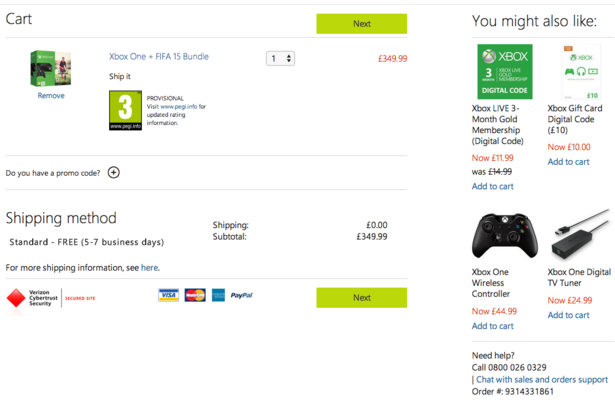
Otherwise it’s well laid out, relatively uncluttered, reveals faster payment options such as PayPal and finds room to offer other essential items you might like with clear pricing.
When I click next though I’m presented with a Microsoft sign-in screen. This would be fine if a customer had an account, in fact I do have a Hotmail account and my email address was already filled in for me, however this could be a huge barrier for some people.

This is the rather lengthy account registration form...

There’s also a Captcha at the bottom of the page for added mirth. I once again have to verify my email address.
When all that’s over with checkout is relatively smooth, but frustratingly I have to fill in my name and address details again.

The only saving grace is that autofill has been enabled, and at least when it comes to payment I can just use PayPal, saving on another page’s worth of data entry.
When compared to the Sony Playstation experience, Microsoft’s store is wonderful, purely because it works. It’s not without its faults, having to sign up for an entire Microsoft account is a huge barrier for conversion and should be presented as an option after the purchase has been made, but at least I probably would have perservered with my purchase.
With the Playstation site, I can count into double-digits how many times I would have abandoned my purchase.
For more brands engaging in digital battle check out:
Our Festival of Marketing event in November is a two-day celebration of the modern marketing industry, featuring speakers from brands including LEGO, Tesco, Barclays, FT.com and more.

