Tuesday, 4 November 2014

Cathay Pacific unveils new responsive site, but fails to optimise checkout

A few weeks ago I reviewed the state of web design in Asia’s airline industry.

It was surprising to find that these major brands expected customers to put up with clunky, out-dated web forms and a difficult purchase journey.

But Cathay Pacific was clearly already aware of the issue and has just unveiled a new responsive site as part of a wider rebranding exercise that seeks to present a “simpler, cleaner, more customer-focused Cathay Pacific brand.”

I’d like to claim that my blog post spurred it all, but it actually comes after 18 months of planning.

The resulting philosophy will guide the design of “new websites, lounges, cabins, in-flight service, entertainment products” and more.

From our point of view the most interesting feature is the new website. So, what’s it like?

Homepage and search tool

Cathay’s site now has a clean, uncluttered design that befits its new customer-focused ethos.

The image of the junk boat set against the Hong Kong skyline is perfect for the brand, and it’s pleasing to note that it doesn’t use a homepage carousel.

The booking tool doesn’t exactly jump out at you but it does have a prominent position on the site.

Further down the page there are links to the latest flight deals departing from the user’s city, as well as links to destination guides and other useful content.

Selecting flight options confused me slightly at first as most airlines show two separate calendars – one for the departure date and one for the return journey.

However Cathay Pacific asks passengers to select both dates within the same calendar view. This is simple enough, but wasn’t what I was expecting.

The process is obviously the same on mobile, although the calendar only appears after the user has selected their destination.


Booking flights

Cathay’s new booking process is far simpler than the previous version.

This table makes it easy to compare the costs of flying on different days, though it could be improved by drawing more attention to the cheaper flights.

Cathay could potentially also improve conversions by using stock levels to create a sense of urgency among customers, but it might see this as a tactic for budget airlines.

At the next stage (page three of seven) Cathay offers passengers a quite baffling range of options.

There are six different choices ranging from £631.36 to £2,459.36, and this is only in economy. What if I wanted to fly business class?

Each economy class has slightly different criteria relating to upgrades, cancellations and ‘no show charges’, which doesn’t quite fit with the aim of creating a simpler customer experience.

It’s also at this stage that passengers have to choose the time of their departure, with the results now including scarcity indicators to create a fear of loss.

There are four more pages in the booking process so I won’t bore you with each one, but suffice to say that it retains the simple, clean aesthetic and is a vast improvement on the old site.

Costs are clearly presented upfront so passengers know what they’re paying for and won’t be fearful of hidden extras.

Cathay also offers a guest checkout and only asks customers for very basic personal information. The use of white space and large text fields means forms are very simple to complete.

The downside...

Sadly it appears that Cathay hasn’t yet got round to optimising the booking process for mobile, which rather defeats the purpose.

Having performed the initial search on mobile, users are then expected to select their flight and complete a seven-stage payment process using a desktop site.


Clearly nobody is going to bother doing this so hopefully Cathay Pacific has plans to roll out an upgrade soon.

In fairness it’s unlikely that many people will actually convert on mobile, but it would have made sense to make the results page responsive at least so people can check their options before making a purchase on desktop.

In conclusion...

Cathay Pacific’s new site is a vast improvement on the old version, though that isn’t particularly difficult to achieve.

But even so the airline deserves praise for recognising and addressing the issue while many of its competitors are happy to make do with out-dated, difficult websites.

The failure to optimise the flight search and booking process for mobile is a huge issue, but I would suspect that Cathay will make this upgrade at a later date.

It could be that the company has adopted a test-and-learn approach so later iterations will include improved functionality.

I certainly hope this is the case, or Cathay Pacific will have already fallen short of its rebranding goals.

Start Me Up! TreSensa: branded HTML5 games for mobile

Mobile is hot, HTML5 is hot, branded experiences are hot. What's not to like about TreSensa?

I caught up with Robert Grossberg, CEO of TreSensa, to see how the young company is faring.

Take a look..

In one sentence, what is your product/service?

TreSensa is a native marketing platform for mobile that leverages branded “tap and play” HTML5 games (no app store download required) to connect brands with their target audiences at scale on mobile.

What problem(s) does it solve?

Brands are struggling to reach their core audiences, such as moms and millennials, because people are now spending more and more of their media time on mobile, and existing brand marketing on mobile does not resonate. TreSensa allows brands to engage their target audience on mobile by providing the content people like most on mobile – gaming.

mobile game titles

What are your immediate goals?

Our immediate goal is to take our brand engagement offering to market with our newly hired sales team and become the leading native marketing platform on mobile.

What were the biggest challenges involved in building the tech or your team?

In terms of the tech, when we started 3 years ago we focused on how to leverage HTML5 to support quality game play right out of the mobile browser. This was a deep technical challenge, as the HTML5 standards were nascent and games are the most taxing form of content for a mobile browser. We assembled a small but highly experienced team, took on the challenge, and nailed it. 

How will the company make money?

TreSensa charges brands on a cost-per-engagement basis for branded games distributed as content across TreSensa’s distribution network. An engagement defined as a unique game session of 60 seconds or more.

Who is in your team?

TreSensa has an office in NYC and SF, and employs 14 people, split fairly evenly between tech/product and ops/sales/production employees.

Where would you like to be in one, three and five years’ time?

In one year I would like to see TreSensa universally recognized as the leader in mobile brand engagement. Within three years I would like to see TreSensa surpass the $100m annual revenue mark. Within five years I would like to see the majority of all major brand campaigns include a mobile web game component and TreSensa supporting the bulk of that business.

Other than your own, what are your favorite websites / apps / tools?

In the office, we use Seamless to order our food every day – it makes the whole lunch process all very convenient.  

Outside the office, the two apps I use most are HotelTonight and Daily Celebrity Crossword.

How the GOV.uk team future-proofed its web strategy

Along with many others, we've been full of praise for the Government Digital Services at Econsultancy.

This is why we have two speakers from GDS at next week's Festival of Marketing.

Creative Director Russell Davies is one of our headliners, and here he provides an insight into the process and strategy behind improving every aspect of the government’s online presence. 

Could you give us a brief preview of your presentation at the Festival of Marketing?

There’s at least a week to go yet. Too soon to tell.

What is your role at GDS?

Director of Strategy. That means lots of things but mostly, in this context, it means knowing enough about marketing and communications to stop us doing all the marketing and communications things most organisations do.

This may seem a silly question, but how big a job is merging the various government departments and bodies into GOV.UK?

Pretty big. It involves moving more than 300 agencies and ‘arm’s length bodies’.

We’ve created or updated about 120,000 pieces of content and trained more than 1,000 people in user needs, writing for the web and how to use the publisher tool. We’ve got a blog devoted to the process.

We were very impressed by the GOV.UK style guide. What was the thinking behind this? 

We have a style guide because our main responsibility on GOV.UK is to make our language clear and consistent.

That means that the thousands of people who write write for GOV.UK need to know what clear and consistent looks like. Simplifying things hasn’t always been a core government skill so having a defined set of rules is helpful.

How do you find the right tone of voice in your copy?

There’s no particular tone of voice we’re looking for. The tone is a product of using as few words as possible, optimising so people using a search engine can find the right stuff and being clear and accessible.

For instance, we aim at a reading age of about nine.

The priority is explanation, not persuasion. We don’t aim to engage - we aim to deliver. 

How do you measure the success (or otherwise) of GOV.UK? Do you have targets to achieve?

Lots of ways. We measure everything. But, in essence, every page on the site should be responding to a defined user need.

Our aim is to address that need as quickly, clearly and efficiently as possible. Do that right and we’ll improve services and save money.

For instance, here’s a post about a prototype that will eventually show the user need behind each page on GOV.UK, among other things.

How has reporting culture evolved at GDS (analytics dashboards etc)?

Well, our aim is to have public dashboards for everything. We’re not there yet, but we’ve made a good start

GDS has received praise from many quarters for its work over the last few years, but what do your users think?

Hopefully most of our users don’t think about or notice us. They just use the service and get on with their lives.

But usage has been going up every month. We do user research all the time and people seem to like what we’re doing - satisfaction scores are pretty high.

But there are always things that can get better, the site can always improve. Probably the most significant thing we’ve done is to make that improvement routine and easy - GOV.UK’s not perfect but it’s always getting better.

The GDS team seem to have been given free rein to implement digital strategy, has this been the case? In other words, how have you been able to be so agile in what people would assume is a very hierarchical environment?

We certainly don’t have free rein, but we have changed the central organising principle for digital services to be about user need.

So as long as we’re doing the right things for users and we’ve got data to back that up, we can generally get on and do the right thing.

You’ve talked about ’the strategy being the delivery’ - can you explain what you mean by this?

As Simon Willison said “You can now build working software in less time than it takes to have the meeting to describe it”.

Digital transformation is not about lots of thinking, it’s about lots of doing. You can’t know what your strategy is until you’ve started delivering things.

Mike Bracken’s written a blog post about why this is so important.

GDS is very open about the thinking behind its strategy, new products, changes etc - why have you taken this route and what benefits does it deliver?

Well, partly, the taxpayer’s paying for all this - why shouldn’t you know what we’re up to?

But secondly, making things open makes things better. It’s a lesson the open source community learned years ago. We’re just widening the scope of the idea.

Thirdly, we have a huge number of ‘internal stakeholders’. The best way to reach them is to make everything public.

How do you attract great staff?

We give them big important problems to work on. Stuff that matters.

Does work suffer in an election year?

Don’t know yet. We’ve not been around long enough to know. I can’t see it being a big problem.

Which service redesign has given you greatest satisfaction?

You’re going to think this is incredibly dull, but probably Prison Visit Booking. You can see a video about the service here:

It’s not sexy, but it’s important. And it hints at the future for government services: Government as a Platform.

Since MOJ built this service and made the code open source we now have code and design patterns for making appointments. Any other bits of government can now take that code and very easily build services for booking driving tests, or job interviews, or whatever they need.

They don’t have to pay anyone for that, they make the code base better and users start to see consistent design patterns across government. 

Russell Davies and Mike Bracken from The Government Digital Service will both be speaking at our two day Festival of Marketing event on 12-13 November. 

Monday, 3 November 2014

Content Marketing Is The Only Marketing Left

This is a quote from Seth Godin after hearing the definition of content marketing back in 2008: Content Marketing is all the marketing left! At the AWeber Ascend Digital Marketing Summit, I shared my view on how the future of marketing is all about content marketing. I talked about how content marketing, storytelling and brand publishing are more than just buzzwords. Here is a transcript of the talk and a link to the slides and videos I shared. Stories have helped us connect with our fellow human beings since the dawn of time. But as we have evolved, each new [...]

The post Content Marketing Is The Only Marketing Left appeared first on B2B Marketing Insider.

The current social media landscape: statistics

The last time we heard, Facebook was struggling with ‘waves of disenfranchised youngsters looking for a hipper alternative’.

Twitter is apparently struggling, with a drop in daily engagement, projected sales for the next three months falling short of expectations and a stock price plummet.

Instagram has stuck the knife into fledgling platform Vine by offering similar video capabilities for its already large incumbent audience. Brands seem to prefer it too. 

It’s not looking pretty out there for our favourite social networks. Of course, whether you trust any of the above reports depends heavily on how much sway you have with the respected sources and how much confirmation bias is at work.

Let’s take a look at some actual statistics to see how healthy social media channels are in 2014.

I’ll be using We Are Social’s latest Digital Statshot which brings together some interesting statistics from around the world from various different sources.

I’ll also be looking at the social media stats from our own Internet Statistics Compendium updated last month, which gives some helpful insight for brands. 

Active users by social platforms

The number of Facebook active users grew 2.3% in the past quarter to 1.35bn. This is up from 1.23bn in 2013.

However Facebook’s own data suggests that growth in some its key countries, notably India and Indonesia, has slowed considerably in recent months. Although this may be down to Facebook’s own strategic purging of fake accounts rather than loss of interest.

64m users log into Facebook daily, a 19% increase year over year. Facebook also has 1.12bn active users on mobile, a 29% increase year over year.

Twitter published its own user figure report last month, showing the platform now has 284m active users around the world, a growth from a reported 241m in 2013. According to Twitter’s report, 500m tweets are sent per day, 80% of Twitter users are on mobile, 77% are outside of the US and its social video platform Vine has more than 40m users.

The popularity of mobile chat apps continues to rise, with WhatsApp, WeChat, and LINE all showing strong growth in recent months.

The trend for mobile-first also continues, with more than 80% of the world’s social media users now accessing their accounts via mobile devices.

Brands on social

Globally just 30% of internet users have actually liked a brand’s Facebook page. This is according to GlobalWebIndex survey from July 2014.

A Social Media Examiner survey from a few months earlier reports that only 43% of marketers believe that Facebook is still working for them. However there is an increase in marketers wishing to improve matters, with 64% saying they wanted to increase their Facebook activities.

Facebook still works if you’re a brand, you just have to work a little harder than you did last year to achieve success. Here’s our own head of social Matt Owen with an explanation why some Facebook pages still reach 82% of their fans.

For Twitter, the same percentage of marketers wish to increase their Twitter activity. 

According to a September 2014 report from ExactTarget, tweets from media and entertainment companies receive 23.6 retweets on average.

Most industry tweets are sent between 3pm and 6pm, with Friday being the most popular day. Tweets with photos are by far the most popular, receiving the most engagement.

Here’s Matt Owen again with some fantastic advice on how you can blast your Twitter engagement rates through the roof.

You Can Put A Price On Pinterest

Is Pinterest part of your social media strategy? Include these 15 Pinterest tactics in your marketing plans to drive sales and traffic to your site.

The post You Can Put A Price On Pinterest appeared first on Heidi Cohen.

Do exact match domains still work as an SEO tactic?

While Google has set out to tackle exact match domains of dubious quality, it seems this is an SEO tactic that may still work. 

Indeed, a recent study found that exact match domains were able to rank highly with fewer links and less content than branded competitors. 

I've decided to delve deeper into this issue with some examples and opinions from a cast of SEO experts... 

Exact match domains and search rankings

Exact match domains are those which match the search query precisely, as opposed to domains, such as glassesdirect.com, which merely contain a keyword they would hope to rank for. 

EMDs have been used as a shortcut to higher rankings and, as such, can command high prices. 

Google has been looking to reduce the value of low quality EMDs, but we can still see a few examples. Here, while you can watch movies online on Amazon, Netflix, Sky and many other 'kosher' sites, the SERPs are dominated by what seem to be pirate sites with exact domain names. 

According to Jon Earnshaw, CTO of Intelligent Positioning: 

The proliferation of EMD depends on the sector. There were historically many in the 'watch movies online' and 'pay day loan' related searches. This has a lot to do with the sectors in questions, where there are transient businesses attempting to sell perhaps not 100% bona-fide services. In the movies sector there were also huge amounts of eastern-european TLDs such as keyword.ro  or keyword2.po  

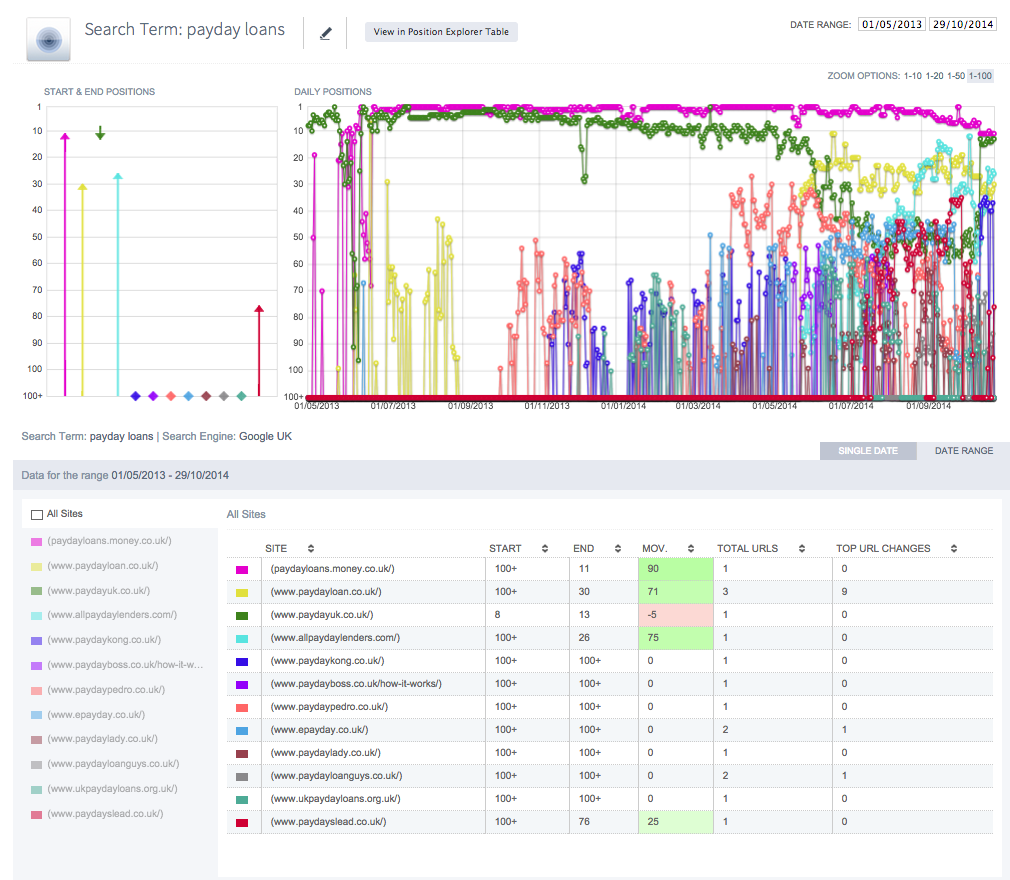
Our toolset collects and stores all returning URLs for particular search terms. Within the payday loans sector and watch movies sectors there are fewer EMDs and very close PMDs than this time last year.  

However, that is not necessarily down to Google, but perhaps down the fly-by-night businesses succeeding and failing in the SERPs - see separate images which show the short termism of their success.  

In this chart, the first batch of EMD sites for loans were prominent last year, and then collapsed:

The second batch shown below are new to the game and have proliferated recently: 
Exact match doesn't always work... 

Here, though cheapflights.com has the exact domain for this query, it still ranks below Skyscanner, while Google's own flight search function has pushed its organic listing further down the page. 

This perhaps shows that it's harder to achieve results with exact domains in more competitive verticals like this one. 

EMDs: the stats

The canirank study mentioned earlier found the following: 

  • Keyword domains rank on average 11% higher than branded domains. 
  • Brand (non-EMD) domains needed an average of 40,000 more links to hit position one, and 35,000 more links to reach the Top 10. 
  • Branded domains needed 69% higher Domain Authority and 22% higher Page Authority to rank in the Top 10.
  • Keyword domains were able to reach position one with half as much content, and only using the keyword half as frequently. 

The report also recommends exact match domains as a shortcut to increased rankings, but is this a wise tactic?

I've been asking SEOs about the value (or otherwise) of such a tactic... 

Are exact match domains an SEO tactic that works? 

Marcus Tober, CTO and founder of Searchmetrics:

Online success does not depend on the domain name. At least not from a technical SEO perspective.

Of course, there are other benefits, such as branding and recognition value,  but our analyses have shown, that the factor 'Keyword in the domain name' as an SEO tactic  has lost its influence over recent years.

Andrew Girdwood, Media Innovations Director at DigitasLBi:

There's an important question of focus. 

If you're planning on entering the competitive jobs board market and cover a range of geographies and industries then an exact match domain probably won't be worth the mega bucks.

On the other hand, if your new site is specifically about "Media Jobs in Glasgow" then you may find an exact match domain suits you. 

An even better SEO tactic is to coin a phrase which gets people searching for your domain. Buy the website "Quote Me Happy.com" before you run an intensive TV campaign around the phrase and injects it into the mind of millions.

Patrick Altoft, Director of Strategy at Branded 3:

It all depends on your goals & how well established your business is. It’s very rare that a major brand would be built on an exact match domain and we see very few examples of an EMD doing well in the long term.

Even if exact match domains were given some kind of boost it’s only for one keyword and when the vast majority of SEO traffic is long tail that isn’t going to help very much. The only way to build a business around EMD’s like this is to either rank for a really big keyword (which you need to be a big brand for anyway) or to have multiple sites (which is hard to do if you want to stay within Googles guidelines).

Kevin Gibbons, MD at BlueGlass:

It really depends on what your goals are. If you're looking to build a long-term brand, I'd say it's probably not the most important thing you should be focusing your time on.

However, if a very high percentage of traffic within your market comes from search, or if you're looking at a shorter-term business model I can see why it would be an appealing approach. 

My thoughts are if you can build a brand long-term - and get in some quicker wins to capitalise on extra organic traffic and double search listings in the meantime - providing you can justify the returns on your effort, why wouldn't you do this? 

Do you think some exact match domains are outranking more worthy sites? 

Marcus Tober:

In the past, exact match domains indeed outranked more worthy sites, even if these keyword domains had only little or even no relevant content, because Google’s algorithm had been much more keyword driven.

But with the EMD Update rolled out by Google in late September 2012, most of these 'spammy' keyword domains have vanished from the search results.

Since Google is a machine, some rather irrelevant exact match domains may probably still be among the top ranking sites, but in the long term, it’s always the quality that matters. Consequently, most of the exact match domains currently ranking at the top are sites do indeed provide some value for the user and are therefore competitive regardless of the domain name.

Andrew Girdwood: 

Weirdness happens all the time. The issue is really how long unexpected results persist. By and large I don't see dodgy domains with nothing but a URL going for them ranking above a site that's worked on both relevancy and authority.

When was the last time you saw a multiple-hyphen-dot-biz domain rank well in Google?

Patrick Altoft:

If you look at the ranking for one specific keyword then perhaps they do sometimes but this isn’t the way to measure SEO – you need to look at total traffic from organic search and an EMD doesn’t help with that.

Sometimes an EMD will outrank a more worthy site certainly, but the key success metric with SEO isn’t what is ranking well today it’s about what will rank well in the future. Google usually gets it right with rankings for big keywords and just because something is working today doesn’t mean it will work after the next update.

Kevin Gibbons: 

Of course. Any ranking of sites (whether Google's algorithm, or someone's opinion) is always going to cause disagreement, because who's to say which sites are more worthy or not?  

Where I most often see exact match domains benefiting is for local sites. The Google Venice update probably isn't spoken about enough (it's penguin and panda relatives have obviously shadowed this somewhat).

But the appearance of local listings (based on searcher location) within competitive and generic queries is now very much commonplace in Google. In some cases could argue that these add value to a searcher, because it's more targeted and localised content - but local domains would be where I'd place my effort in terms of getting the best results.

Is this something that Google needs to deal with? 

Marcus Tober:

Google can measure quality quite well using user signals such as bounce-rate or time-on-site as a signal for relevant content and user satisfaction.

So the search engine already is pretty elaborate in filtering spammy keyword domains, both from a content and a technical perspective. That’s why I think, EMDs are not a current focus for Google.

But of course, there are always new challenges, so the work never ends.

Andrew Girdwood: 

I think this is something Google will need to keep on its radar for a number of reasons. 

One interesting reason is the physiological effect of an exact match domain when the searcher is on a small screen device or using a card based interface.

In the absence of a compelling brand in any set of results then the exact match domain may attract an even larger share of clicks. If the site is good enough to satisfy the search then that will give Google cause for thought.

There is the possible rise of exact match TLDs but then… how often do you see a .jobs site ranking for a job search? 

The third reason I'll leave you with is the ease of site creation these days. Google's Udi Manber said that 20% to 25% of queries on any day are searches Google has never seen before.

It's really easy to create a site with a domain that matches these 'new keywords'.  For example, you see this in computer games; when a new title is announced the first fan sites, places for reviews, tips and communities, tend to have domains named after the computer game.  

When there's a new concept that's gaining traction the first sites that are often the best resource for searchers are exact match domains created to address that new trend.

Patrick Altoft: 

Google is already dealing with the lower end of this with its unnatural link crackdown, we’ve seen plenty of EMD owners being told that their anchor text is unnatural and this makes it harder for them to build links.

The biggest ranking factor these days is engagement so any EMD that isn’t satisfying users will probably drop down the rankings anyway – and if the site is genuinely useful then it deserves to rank whether it’s an EMD or not. 

Kevin Gibbons: 

Yes it is, and although far from perfect, I do think Google have improved as more algorithm signals have been brought in to identify a brand. 

Google is in a difficult situation here, because sometimes it's just not that easy to associate a brand to a specific domain. For example, if a brand query goes up, it makes sense that the exact match domain rankings increase (especially if the listing has a high CTR), but what if that's not really the result people are searching for?

This goes deeper into analysing the intent of the searcher, "Cheap Flights" is always an obvious query example, is this a brand query or a generic search? That's a tough one for Google to fix.

There will never be a real right or wrong answer in rankings, it's always in a state of flux - and that's another reason why personalised search is so important.

It's also important to remember that Google wants to reward brands - this means that they look for common brand signals such as links, anchor text, brand query volume, social engagement, CTRs and bounce rate (from SERPs) etc - and when they find the perfect mix of these factors, I think it will be much harder for exact match domains to benefit from increased coverage.

But until then, have fun experimenting!